- Opening hours by appointment
- +41-78 7 141415
- [email protected]


Biofeedback
Biofeedback - Understanding and Controlling Your Body
What Is Biofeedback?
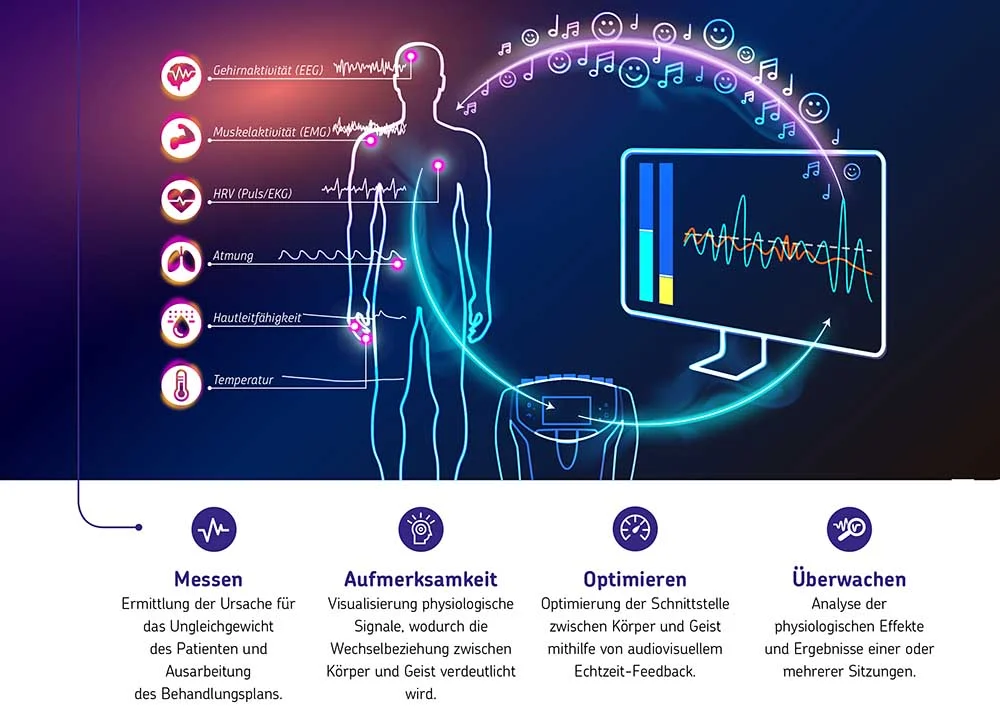
Biofeedback is a precise, non-invasive, and computer-assisted method through which physical reactions such as heartbeat, muscle tension, respiration, and skin conductance are measured in real time and made visible or audible. What normally happens unconsciously becomes perceptible and trainable - you learn to deliberately influence and regulate these processes.
How Does Biofeedback Work?
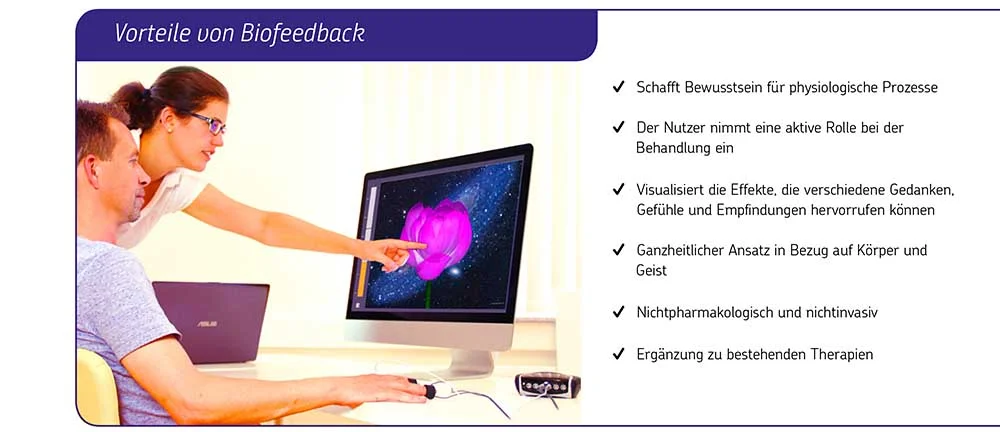
Sensors capture your biosignals on the skin surface; a measuring device and software continuously analyse them and display them via curves, colours, animations, or sounds. You try out breathing, relaxation, or focus strategies and immediately see how your body responds - your nervous system learns to stabilise healthy patterns and let go of stress patterns.
Key Biofeedback Modalities
| Modality | What Is Measured? | Typical Applications |
|---|---|---|
| HRV biofeedback | Heart rate variability - variability of heartbeat intervals | Stress and burnout, anxiety, depression, hypertension, cardiovascular health, peak performance |
| EMG biofeedback | Muscle tension such as forehead, neck, jaw, and back | Tension headache, migraine, bruxism, back and neck tension, posture |
| Skin conductance (EDA) | Electrodermal activity - "fight or flight" response | Anxiety, trauma, emotional over-arousal, stress regulation |
| Temperature biofeedback | Skin temperature as a marker for peripheral blood flow | Raynaud's, migraine, circulatory disorders, general relaxation |
| Respiratory biofeedback | Chest and abdominal breathing, respiratory rate, and depth | Hyperventilation, breathing disorders, panic, sleep, deep relaxation |
HRV - The "Window" to the Autonomic Nervous System
Heart rate variability (HRV) shows how flexibly your autonomic nervous system can switch between activation (sympathetic) and recovery (parasympathetic). High HRV is associated with good stress resilience, better recovery, fewer cardiovascular diseases, and greater psychological stability, while chronically low HRV is a warning signal for overload or disease.
In HRV training, you see in real time how your heart responds to breathing, stress, and emotions, and learn through targeted breathing and relaxation techniques to actively improve your HRV and thus your stress resilience.